



UNR teacher and researcher Elsa Raimondi, the province's first neurologist, devised a project of spontaneous classical music events in the streets that surprises with its originality in difficult times.
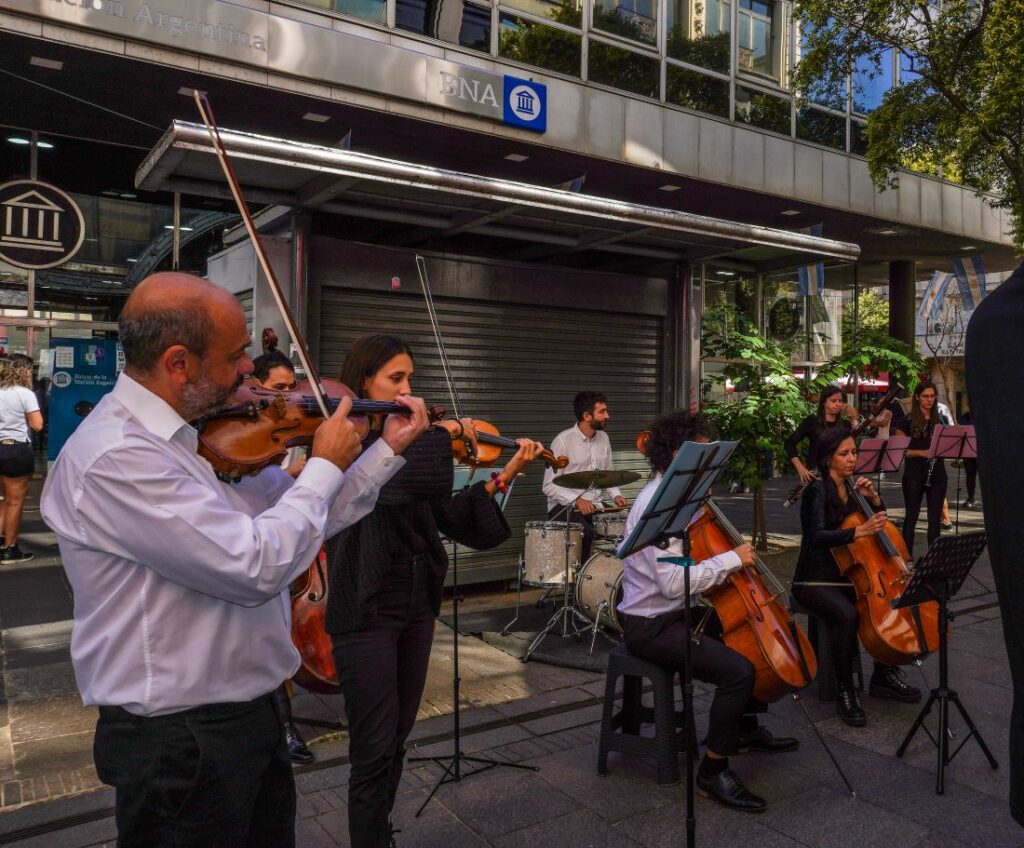
A teacher and researcher from the UNR Faculty of Medical Sciences devised a symphonic project to “restore joy to the people of Rosario.” This is “Mielina Flashmob”, a series of spontaneous classical music events on the street that has already had three presentations in the city and promises to continue.
Doctor Elsa Raimondi, alma mater of this proposal, was the first neurologist in the province and is currently retired. She had this idea after the pandemic, she wanted to do something for the community “that can be enjoyed.” She decided to make it about classical music because it accompanied and motivated her throughout her career. She studied Medicine listening to Beethoven's symphonies on National Radio in the background.
Regarding the name, he explains that “Myelin” is the scientific term for the layer that protects the tissues of the nervous system and allows messages to be transmitted quickly and without interruptions from one cell to another. In the case of this musical project, it would be an artistic expression that seeks to produce pleasant sensations and leave everyday worries behind, even for a while.
The term “Flashmob” translated from English is an instant mass event. This type of short, spontaneous and innovative event in a public space emerged in the United States in mid-2003. Its main characteristic is improvisation and surprising passers-by with very good quality music. The idea is that people passing by look surprised, stop and listen.
“People who can enjoy music are more sensitive,” says Elsa, who admires Beethoven and considers him a genius because since the third symphony he already wrote with deafness. “He had everything in his brain, there he built his vision of what an orchestra should be. Despite his inability, he was able to create something wonderful that he left for posterity.”
The doctor warns that the problem is that to listen to classical music you have to go to a specific place like the El Círculo theater and only those with purchasing power attend. One of the reasons for this proposal is precisely so that many people can freely access this type of music. And although there are many street musicians in La Peatonal, they dedicate themselves to other, more well-known genres.
With that in mind, Elsa contacted the trumpet player of the Provincial Symphony Orchestra and the Municipal Wind Ensemble, Jonatan Bravo. Jonathan comes from a family of amateur musicians, his grandfather and grandmother played the violin and his father the trumpet. He started with this instrument at the age of 10 in an attempt to attract their attention and fell in love with the trumpet. At 14 he already knew that he wanted to play in a symphony orchestra, it was his goal and it took him years, sweat and tears, many tears to achieve it, as he confessed. Entering a professional organization is not easy and requires a lot of preparation. In his case, it was only at the age of 26 that he got in through a competition and became the first professional musician in his family. Today, at 37 years old, he is part of the Provincial Symphony Orchestra and since last year also of the Municipal Wind Ensemble.
Beethoven, Richard Strauss and Gustav Mahler are his favourites because of the depth of their compositions, music that is meaningful to him because it accompanied him in frustrating situations when he could not make a living from his profession. But things changed, in addition to achieving the goal he set himself from a very young age, he is now also the music producer of Mielina Flashmob. When Elsa explained to him that she wanted to give people a moment of joy and that she would take care of paying for it, Jonathan couldn't believe it and thought it was fabulous.
The first step was to call together musicians who were friends of the orchestras in which he participates, taking into account the professionalism and personality of each one in order to form a good working group. He suggested starting with something smaller than an orchestra because they would not need so many adaptations and many scores were already pre-assembled on the internet.
The first performance took place on October 6 in Córdoba between Corrientes and Entre Ríos. There, a wind quintet and a string quintet performed works such as Tchaikovsky's Overture 1812, Toreadores from the Opera Carmen, Coldplay's Viva la Vida and Hava Nagila (Let's Rejoice in Hebrew).
The second took place in Córdoba between Miter and Entre Ríos on December 20. On that occasion there were six of the wind group and a young woman with castanets. They performed Overture 1812, Toreadores de la Opera Carmen, Chatanuga Choo Choo by Glenn Miller, El Gato Montés and Hava Nagila
The third, which took place on March 23 of this year, was the largest intervention with 18 musicians and songs such as Bolero by Ravel, Danza Ritual del Fuego by Manuel de Falla, Light Cavalry by Von Suppé, Tritsch Tratsch by Strauss were heard. , Overture 1812 by Tchaikovsky, Toreadores from the Opera Carmen by Bizet and Hava Nagila.

In the selection of the songs, they combine both perspectives. Jonathan has preferences for more sophisticated themes, like many of his colleagues, whereas Elsa, who is not a musician but is a great listener, leans more towards popular songs, those that people like, those that make you want to applaud.
For Elsa, the attitude of the people in the three presentations was positive and one of the keys was the choice of the repertoire "not solemn but motivating, even for dancing." The idea is to give it continuity over time and to have it be in different open and busy places, such as pedestrian areas and parks. “The purpose is to lift our spirits a little because we are going through a dark period, especially in Rosario,” she says and considers that we are not just insecurity, drug trafficking and economic problems, but something else.
Listening
Elsa went to high school at Normal School No. 2 where she graduated as a national normal teacher. She later studied Medicine at the UNR and received her degree in 1968. She specialized in Neurology, completing four years of attendance in room 3 of the Centenario Hospital.
Remember that the few women in this profession generally specialized in pediatrics, gynecology or clinical medicine. She was the first neurologist in the province of Santa Fe. She attended private offices, in Pami, at the Unión Dependientes Center and made home visits. She also had a teaching career that began as Head of Practical Work, she became Head of the Chair of Neurology at UNR and then Director of the Specialization in Neurology degree. She was president of the Society of Neurology and Neurosurgery of Rosario and Vice President of the Argentine Headache Association.

Regarding the practice of medicine, he states that “before it was very different, more artisanal.” The consultation required an hour in which the doctor had to review and ask questions of the patient. He explains that in Neurology there are several specific semiological maneuvers to reach, first of all, a topographic diagnosis, that is, to locate in which area the lesion is, whether in the brain, brainstem, spinal cord or cerebellum. “But currently only three or four questions are asked and studies are requested,” he laments.
While he was in charge of the Specialization in Neurology, until two years ago, he continued teaching in the traditional way: reviewing, arriving at the diagnosis and only then corroborating it with the corresponding studies. “When it is not possible to cure, it is necessary to relieve and also comfort. Containment is closely linked to the ability to communicate and know how to listen,” she says.
Elsa published works in national and foreign scientific journals and was the author of the books “Headaches in clinical practice” and “Neurology. Episodic Afections” from the Corpus publishing house, as well as some chapters of the book by Alberto Muniagurría and Julio Libman “Clinical Semiology”. Regarding headaches, she says that there is still a lot to research, especially about the neurotransmitters that are in the brain. “15% of female headaches cannot be treated. The causes are genetic, hormonal, dietary, lifestyle.

He also wrote about his trips to the south and north of the country in “Travel Stories”, edited by Homo Sapiens. He was several times in El Chalten where he went hiking and was able to observe his favorite mountains: Fitz Roy and Cerro Torres. Added to this is her love for photography, which led her to participate in several contests.
The musical project has an Instagram account managed by Ariel Oliveri in which the presentations are published: @flashmobrosaro.
Journalist: Victoria Arrabal