


Livestock monitor | 2025 campaign
Argentine Livestock Review 2025: How much milk production grew, how consumption recovered, and why beef generated record foreign exchange earnings. May 2026 Report.
Dairy
With favorable rainfall and improved pastures, raw milk production increased by 9,4% year-on-year in 2025, reaching 11.618 billion liters, one of the highest figures of the last decade. However, we continue to emphasize that primary milk production has remained stagnant in the 10 to 12 billion liter range since 1998.
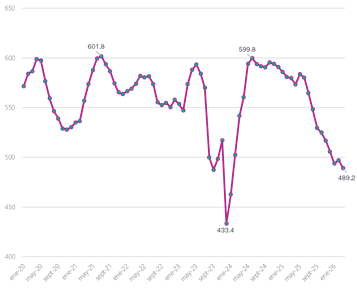
This increase in primary supply during 2025 led to a drop in the price per liter paid to dairy farmers, which, since January of last year, fell by -18,5% in real terms.
Dairy industry costs decreased due to the drop in the price of its main input. This led to a decrease in retail dairy prices relative to other goods in the food basket.
The situation in the supply chain allowed for a recovery in consumption, which, in any case, is still below its historical average of 185,3 liters equivalent per capita per year.
Price per liter of raw milk at the dairy farm (constant to March 2026)
Source: Prepared by the authors using data from SAGYP
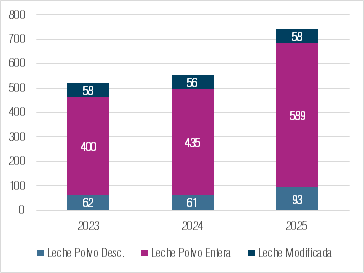
During 2025, powdered milk exports increased sharply. This, along with better international prices, resulted in $200 million more in revenue than in 2024. Even so, exports remain below the levels reached in 2022. Meanwhile, cheese exports remained close to 2024 levels.
Exports of powdered milk in millions of dollars
Source: Prepared by the authors using data from SAGYP
Animal husbandry
Cattle slaughter fell by 2,5% and production by 1%, totaling 3,14 million tons. The liquidation of breeding females continues, and the replacement of female cattle is slow, so a lower supply is expected in the short term. Meanwhile, poultry production remains stable, while pork production continues its upward trend.
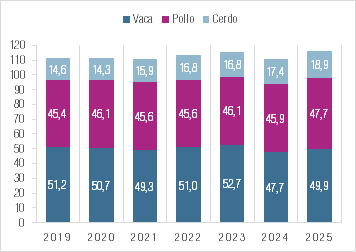
Domestic meat consumption recovered during 2025. The average Argentinian consumed 2,2 kg more beef, 1,8 kg more chicken, and 1,5 kg more pork than in 2024.
Annual per capita meat consumption
Source: Prepared by the authors using data from SAGYP
However, a relative price increase for beef compared to other meats is evident in the short term due to both internal and external factors. On the supply side, the cattle herd is at its lowest level since 2011. On the demand side, the Argentine government negotiated new trade agreements with the United States. These generated greater external demand at higher international prices.
This combination of factors led to a significant increase in the domestic retail price of beef, well above the rate of inflation. This trend is likely to continue for the remainder of the year, with consumers substituting beef for other meats.
Relative price of roast beef vs. chicken and vs. pork belly. Last 5 years.
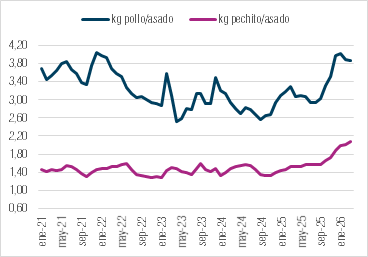
Beef exports decreased by 8,8% in volume during 2025. However, the sharp increase in international prices (+41%) allowed for a historic increase in foreign exchange earnings, exceeding $3700 billion from beef exports.
Open access, for use and citation
The report is available freely and without charge, under a Creative Commons license (CC BY 4.0):
- 📄 Full report (PDF): Download the report
- 🗄️ UNR Hypermedia Repository (RepHip): https://hdl.handle.net/2133/34071
- 📚 More reports from the Observatory: Index of Reports
Monitor Ganadero – Campaña 2025. Informes del Observatorio UNR N.º 78 — Serie Informes de Coyuntura N.º 36, mayo de 2026. ISSN 2683-9067 / 2683-9075. Autor: Alfredo O. Bula.