


Monetary policy is the set of decisions and measures taken by a country's monetary authority to influence the cost and availability of money in the economy. Our report examines monetary policy in Argentina and includes:
- The foundations and goals of monetary policy
- Evolution of international reserves
- Evolution of the BCRA's Assets and Liabilities
- Analysis of interest rates, inflation and exchange rates

Summary of the current government's monetary programo
In December 2023, a “non-disruptive monetary regime change” was launched to correct existing imbalances. Since then, the monetary authority has focused on developing endogenous monetary policy instruments.
First, LELIQs were transformed into passive “passes” with a one-day term, then on July 22, 2024, the suspension of passive pass operations was ordered and the “Liquidity Tax Bill” (LeFi) was established as the main liquidity management instrument of the banking system.
In April 2025, a new agreement was signed with the IMF that involved restructuring Argentina's debt and obtaining new loans to strengthen the Central Bank's reserves and stabilize the economy. (The United States government politically supported this aid.) In exchange, Argentina committed to implementing structural reforms and economic policies that include fiscal, monetary, and exchange rate targets.
In the first months of 2026, the Central Bank of Argentina (BCRA) maintained its monetary policy stance unchanged while the economy resumed its disinflationary path, inflation expectations remained anchored, and financial conditions remained stable. (During the first quarter, the consequences of the Iran-US war had an impact.)
So far in 2026, the central bank has expanded its monetary policy scope by strengthening its external position, accompanying the reversal of the dollarization of private sector portfolios by buying reserves.
For the following months, the BCRA authorities anticipate that the demand for money will increase as the credit expansion cycle progresses and the recovery of economic activity strengthens.
What's coming in terms of monetary policy: the government announced that it will send a comprehensive reform project to the Organic Charter of the Central Bank of the Argentine Republic (BCRA) that introduces structural changes designed to eliminate monetary financing of the fiscal deficit and protect the entity's autonomy from political fluctuations.
- The report accompanying this note provides a summary of the most important monetary variables….
INTERNATIONAL RESERVATIONS
These are the funds in dollars or other foreign currencies that the country holds, originating from exports or loans. They can include public funds, such as those from loans, and private funds, such as those deposited by savers in the banking system.
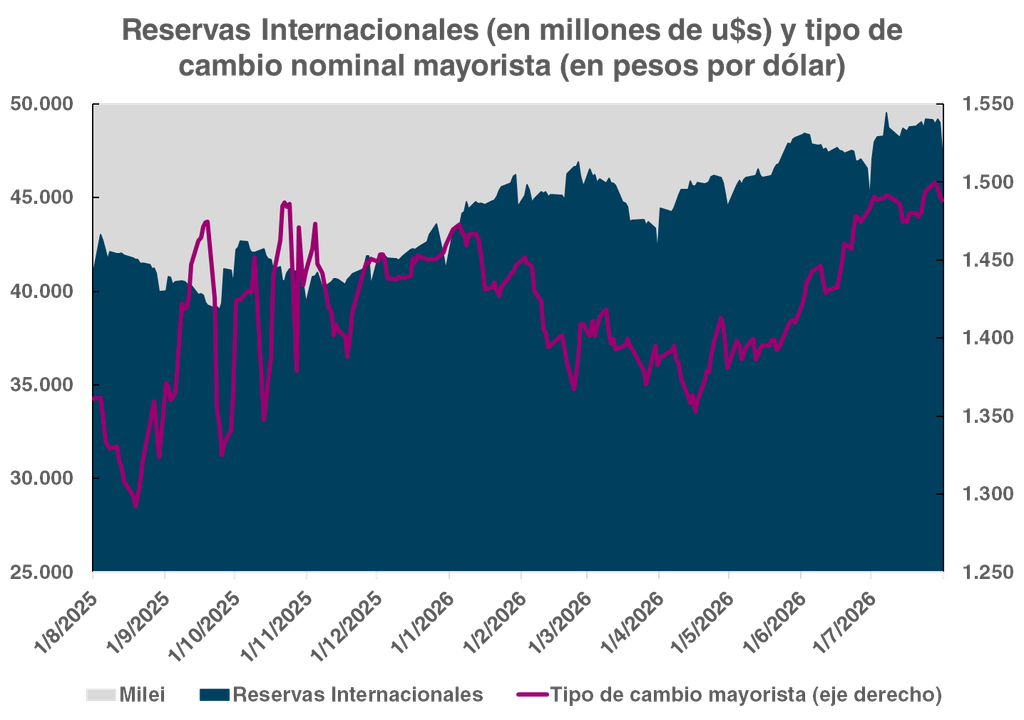
Situation as of July 31, 2026
With the 2025 election period over, during 2026 the Central Bank added more than USD 13.000 billion in net purchases, driven by interventions in the official market.
Currently, both the current and financial accounts showed positive results, a rare occurrence in the country's recent economic history. Foreign exchange earnings were primarily driven by the dynamism of the agribusiness, energy, and mining sectors.
Source: BCRA
BCRA ASSETS
Assets are the goods and rights that a bank holds over the rest of the world. A central bank's assets include the following: gold and foreign currency, loans (to banks and the public sector), securities portfolios, among others.
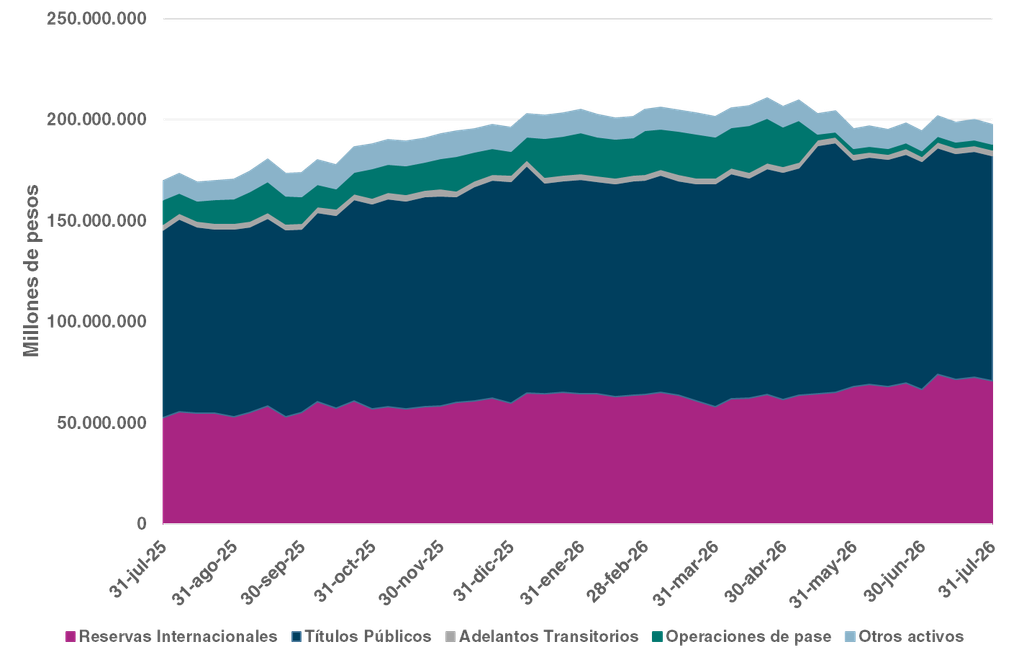
Situation as of July 31, 2026
During 2026, the assets of the Central Bank of the Argentine Republic evolved within the framework of the cleanup of its balance sheet and the elimination of fiscal dominance, reflecting a gradual recovery of international reserves and less assistance to the public sector
Evolution of the BCRA's assets
Source: BCRA
BCRA LIABILITIES
These are the debts that the bank has contracted and therefore include the reserves that private banks have deposited, the deposits made by public administrations and the banknotes and coins in circulation.
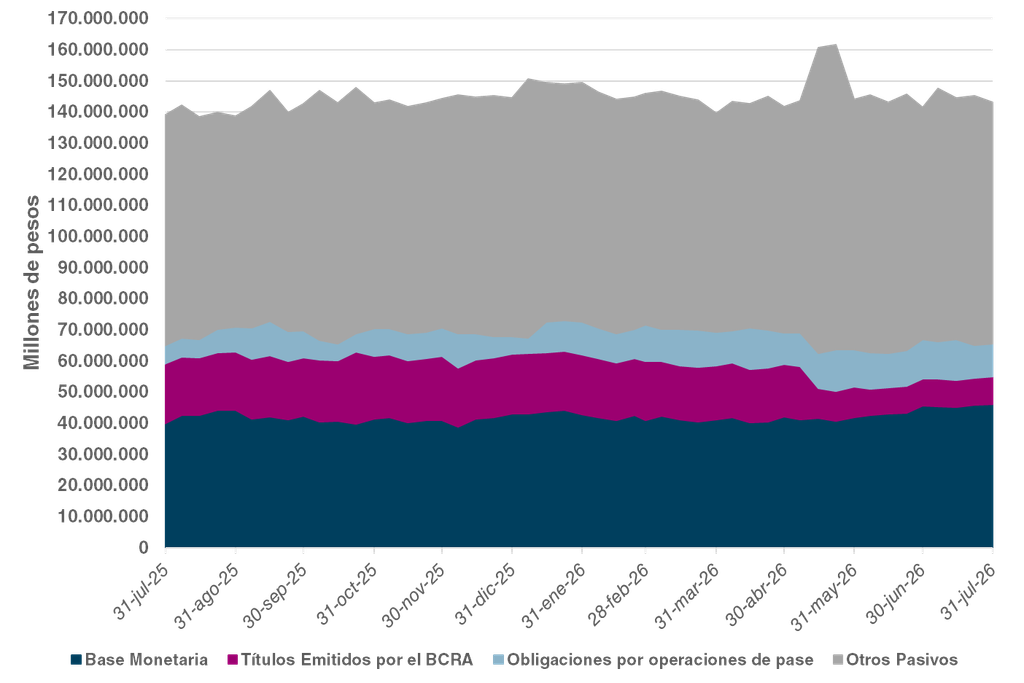
Situation as of July 31, 2026
The Central Bank of Argentina shows a slight nominal expansion of the monetary base but a contraction in real terms. This dynamic reflects a phase of economic re-monetization and balance sheet consolidation, avoiding further sterilization efforts after the prior transfer of interest-bearing liabilities.
Evolution of the BCRA's liabilities
Source: BCRA
- Regarding the situation of the BCRA's assets and liabilities, the report shows how the composition of both evolves, with the aim of achieving the cleanup of the entity, an objective that is being achieved.
REFERENCE INTEREST RATES, INFLATION, ITCRM and EXCHANGE RATE
The monetary policy rate indicates the policy bias adopted by the monetary authority to achieve its inflation targets. The report is also complemented by inflation data and the main exchange rates (official, MEP, CCL, blue, card).
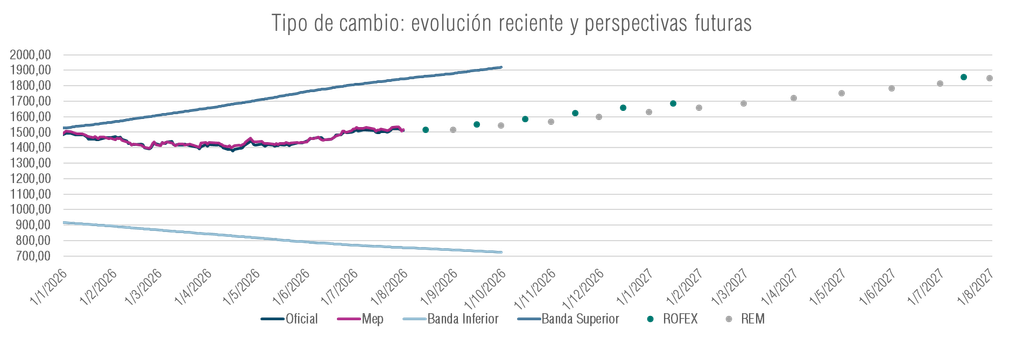
Situation as of July 31, 2026
Following the agreement with the IMF, the liberalization of currency controls was implemented, which significantly reduced the exchange rate gaps between the different exchange rates. Furthermore, inflation rates and future projections are trending downward for the second half of 2026, after the rebound in the previous six months.
Source: REM and Matba-Rofex