
Monetary policy is the set of decisions and measures that a country's central bank uses to influence the cost and availability of money in the economy. Our report examines these measures as applied in Argentina and includes:
- The foundations and goals of monetary policy
- Evolution of international reserves
- Evolution of the BCRA's Assets and Liabilities
- Analysis of interest rates, inflation and exchange rates
- The future macroeconomic forecast
Monetary outlook in the last government
In December 2023, with the assumption of power by the new authorities, a "non-disruptive monetary regime change" (as the Central Bank itself called it) was launched, with the aim of correcting the current imbalances.
From that moment on, the monetary authority focused on working on endogenous issuance instruments, that is, instruments that form part of the BCRA's liabilities and accrue interest.
First, on December 18, 2023, LELIQs were transformed into passive one-day "repos" (passes). Subsequently, on July 22, 2024, the suspension of passive repos operations was ordered, and the "Letra Fiscal de Liquidez" (LeFi) was established as the main liquidity management instrument for the banking system.
In April 2025, a new agreement was signed with the IMF (specifically, a 48-month Extended Facility Agreement (EFA)) that involves restructuring Argentina's debt and obtaining new loans to strengthen the Central Bank's reserves and stabilize the economy. In return, Argentina commits to implementing structural reforms and economic policies that include fiscal, monetary, and exchange rate targets.
From 2026 onwards, the strategy is based on seeking to accumulate dollars through purchases in the open market.
The report accompanying this note provides a summary of the most important monetary variables….
INTERNATIONAL RESERVATIONS
These are funds in dollars or other foreign currencies held by the country. They come from exports or loans received by the country and are controlled by the Central Bank. They may include public funds, such as those from loans, and private funds, such as those deposited by savers in the banking system.
Situation as of March 31, 2026
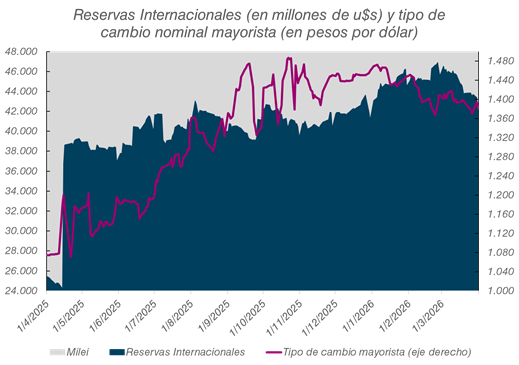
Once the electoral process in the country concluded (October 2025), reserves remained stable and increased slightly. In 2026, the central bank began a process of buying dollars, a pace it maintained on most business days, but debt payments prevented an increase in the overall level of reserves.
BCRA ASSETS
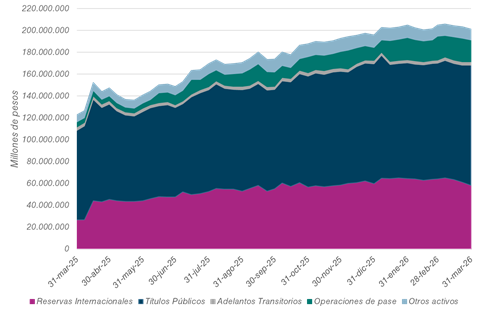
Assets are the goods and rights that the bank has over the rest of the world. The assets of a Central Bank include the following items: gold and foreign currency, credits (to banks and the public sector), securities portfolio and finally its own real estate or furniture.
Situation as of March 31, 2026
In July 2024, changes to the valuation criteria for Non-Transferable Treasury Bills led to their decline, while in April 2025, the entry of the IMF loan explains the growth of International Reserves within total assets.
Evolution of the BCRA's assets
BCRA LIABILITIES
These are the debts that the bank has contracted and therefore include the reserves that private banks have deposited, the deposits made by public administrations and the banknotes and coins in circulation.
Situation as of March 31, 2026
The Central Bank of Argentina (BCRA) has decided to close the window for reverse repos as of July 22, 2024. With the IMF loan, the National Government's deposits are increasing. Regarding the BCRA's liabilities, the first months of 2026 showed a slight nominal expansion of the Monetary Base, but with a continued contractionary bias in real terms.
Evolution of the BCRA's liabilities
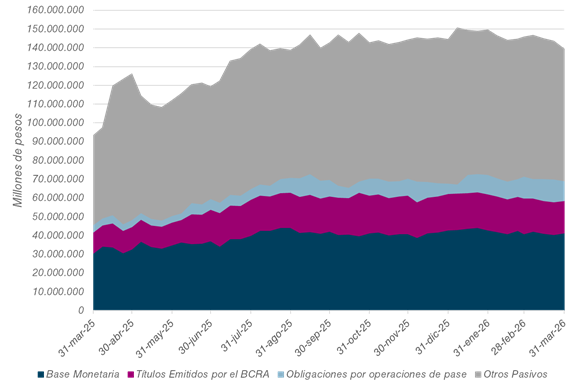
IN CONCLUSION: Regarding the situation of the assets and liabilities of the BCRA, the report shows increases in both, with an improvement (greater growth) of assets in relation to liabilities, with the aim of achieving the recovery of the entity.
REFERENCE INTEREST RATES, INFLATION, ITCRM and EXCHANGE RATE
The monetary policy rate indicates the policy bias adopted by the monetary authority to achieve its inflation targets. The report is also complemented by inflation data and the main exchange rates (official, MEP, CCL, blue, card).
Situation as of April 30, 2026
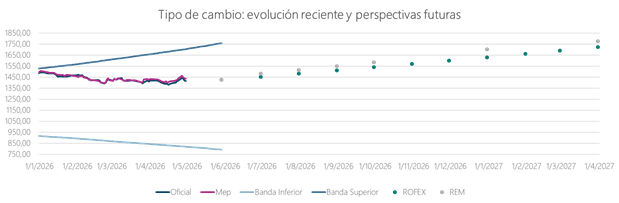
Following the agreement with the IMF, the liberalization of currency controls was implemented, which significantly reduced the exchange rate gaps between the different exchange rates. Regarding inflation rates and future projections, they have been rising since mid-2025, although they are expected to decrease in the second quarter of 2026.