



Undergraduate Diploma in Forensic Economic Analysis
Created by Res. CS No. 565/2021 in person. And virtual mode by Res. CS No. 047/2022.
:: INFORMATION and REGISTRATION: diplomaturaaef2025@gmail.com
Coordination academic:
Prof. Daniel Erbetta
Dr. Marina Marsili
Prof. Sebastián Narvaja
Prof. María Cecilia Vranicich
Executive Coordination:
Agustín Carrara
Management Secretariat:
Ayelen Papurello
Content Secretariat:
Manuela Losada
:: RATIONALE:
The Diploma aims to provide high-level technical training for the development of capacities of the members of Public Agencies involved in confronting economic crime. The program aims to develop these skills by addressing different subjects related to the field of economic and legal sciences.
Economic crime constitutes a problem of significant social relevance. A large part of current criminal activity recognizes links with various forms of economic crime: money laundering, massive fraud, tax evasion, corruption of officials, corporate fraud, cybercrimes, extortion and trafficking of prohibited substances, among others.
Likewise, the proliferation of various forms of economic crime has a direct impact on the growth of problems such as the unequal distribution of access to goods and services, the increase in poverty, the deepening of conflicts that generate violence, damage to the environment and democratic coexistence itself.
Our vision is that the Public University contributes to the training of cadres capable of mastering these disciplines with a focus on criminal investigation, which is of vital importance for these times.
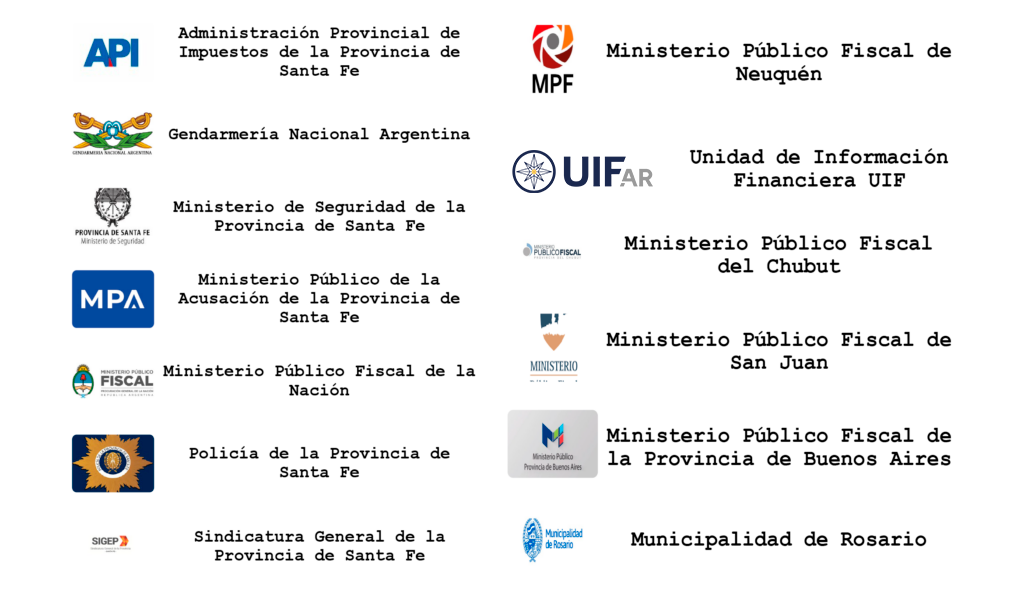
Beneficiary institutions:
The Diploma has already formed three cohorts of analysts, in its 2022, 2023, and 2024 editions. These individuals are members of the analysis, research, and prevention bodies of the following institutions:
:: DURATION AND MODALITY:
The diploma will be delivered in ten virtual and asynchronous modules, which will consist of theoretical and practical classes and an Integrative Final Evaluation. To obtain the certification for the Diploma, the
students must:
- Pass all the reading tests that will be provided during the course
- Pass the practical assessments corresponding to each module. These will be individual and/or group assessments and must be submitted in writing.
- Pass the Final Integrative Evaluation, which will consist of completing a final project in pairs that must then be defended orally.
:: GRADUATE PROFILE:
A forensic economic analyst capable of:
- Analyze the economic activity of organizations of all types, relating accounting aspects to their legal, tax and financial aspects;
- Produce information according to the needs of criminal investigations
- Produce reports for decision making within criminal investigations
- Write reports on the analysis and research tasks carried out
2025 edition
:: ADMISSION REQUIREMENTS :
The diploma program requires applicants to be over 18 years of age and have a high school diploma. Applicants must also be members of federal, provincial, and municipal public agencies involved in the investigation, control, and/or prosecution of economic crime, as well as members of institutions that work with the same vision, such as non-profit civil society organizations, educational institutions, and regional or international organizations. To enroll, students must present:
- Complete registration form (SIU Guaraní).
- Certified copy of ID or passport and copy of birth certificate.
- Documentation proving your membership in one of the previously mentioned institutions.
:: PROGRAM:
Asynchronous virtual modules:
1. Introduction to economic crime and economic criminal law – Part One
The course will begin by understanding what economic crime entails. It will address economic criminal law, its connection with criminal policy, and some legal specifics such as the criminal liability of legal entities. Specific crimes will be studied, covering, among others, fraud and embezzlement, company depletion, corruption offenses, and crimes against the economic and financial order. It will also examine a fundamental criterion of interpretation in economic crimes: the principle of economic reality. To this end, the Supreme Court's jurisprudence on the subject will be analyzed, along with the impact of this principle on the approach that should prevail in the conduct of investigations.
2. Introduction to economic crime and economic criminal law – Part Two
The course will begin by understanding what economic crime entails. It will address economic criminal law, its connection with criminal policy, and some legal specifics such as the criminal liability of legal entities. Specific crimes will be studied, covering, among others, fraud and embezzlement, company depletion, corruption offenses, and crimes against the economic and financial order. It will also examine a fundamental criterion of interpretation in economic crimes: the principle of economic reality. To this end, the Supreme Court's jurisprudence on the subject will be analyzed, along with the impact of this principle on the approach that should prevail in the conduct of investigations.
3. Introduction to Accounting
The principles and standards of accounting will be analyzed as a financial management tool that allows for the systematic and orderly recording of financial documents.
4. Audit
Classifications, types of audits, and procedures commonly applied to verify accounting criteria (recording and valuation) used for the main accounting accounts will be addressed.
5. Financial Statements
Techniques for preparing financial statements will be addressed; valuation criteria and recording of economic events at different times in the life of the company and analysis of liquidity and solvency indicators.
6. Economic crimes: special part
Building on the concepts and tools from previous modules, we will address general economic crime investigation issues and delve deeper into specific crimes and related criminal and non-criminal regulations.
7. Money laundering and virtual assets
Money laundering will be addressed from a comprehensive perspective, taking into account the state actors involved and the usefulness of detecting these maneuvers. Techniques for identifying suspicious activity will be analyzed: economic, asset, and tax analysis associated with money laundering investigations. Related to this, the structure and modes of operation of criminal markets will be addressed.
General aspects of virtual assets and the challenges that arise in the investigation and prosecution of these cases will also be addressed.
8. Asset Recovery
Efforts will be made to identify economic actions aimed at ensuring the confiscation of assets that result from the proceeds or benefits of a crime and their instrumentalities, as well as the collection of fines and court costs and reparations to victims.
9. Planning an IPP, testing and intensive data management – part one
Strategic planning will be addressed as a management tool to guide the IPP based on a theory of the case, determining the evidence necessary to support factual propositions—statements of fact—linked to applicable legal theories. This will involve identifying the main challenges associated with case planning and working with facts, law, and evidence, particularly in cases involving intensive data handling.
10. Planning an IPP, testing and intensive data management – part two
Strategic planning will be addressed as a management tool to guide the IPP based on a theory of the case, determining the evidence necessary to support factual propositions—statements of fact—linked to applicable legal theories. This will involve identifying the main challenges associated with case planning and working with facts, law, and evidence, particularly in cases involving intensive data handling.
Course start date: August 11, 2025
End of course: December 22, 2025
Submission of the Final Integrative Evaluation: February 16, 2026
Oral defense: March 2026
:: INFORMATION and REGISTRATION: diplomaturaaef2025@gmail.com
Attachments