



How grain production fared in Argentina during the 2021/22 season, how much is lost to soybean producers, and why agricultural exports sustain the economy. November 2022 report.
The Argentine economy as a whole is largely sustained by the agribusiness sector, which is the main generator of foreign exchange. Grain production in our country reached 143 million tons (MTn) across 42 million hectares (Mha) sown for the 2021/22 season, the second-highest production figure on record and a record for land use for intensive crop farming.
Sown area and production 2021/22
According to the Ministry of Agriculture, Livestock and Fisheries (MAGYP), over 42 million hectares were allocated for these purposes in the 2021/22 season. The three main crops in terms of area continue to be soybeans (16,1 million hectares), corn (10,7 million hectares), and wheat (6,7 million hectares). Three other crops exceed one million hectares sown: sunflower (2 million hectares), barley (1,6 million hectares), and oats (1,4 million hectares). The area dedicated to sorghum production was around 950 hectares in the last season.
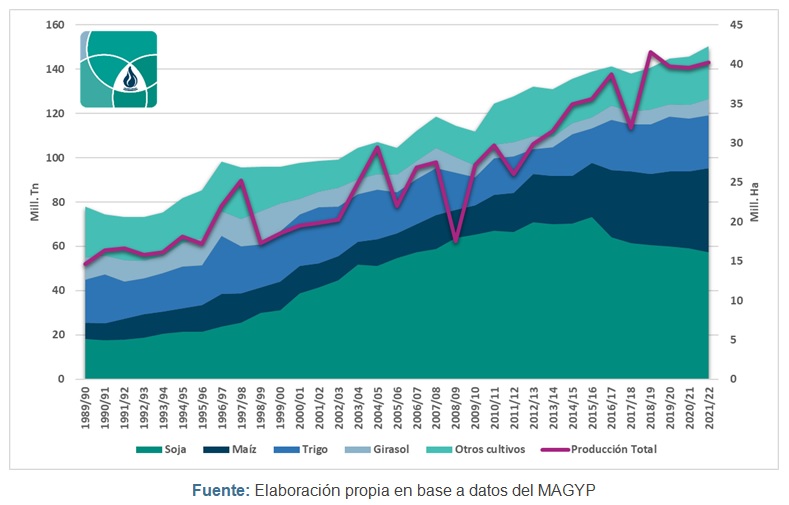
Superficie sembrada por cultivo y producción total de granos, campañas 1989/90 a 2021/22.An increasing proportion of soybean and corn crops are late-planted (second-crop). This is compounded by persistent water scarcity (the fourth consecutive La Niña event). As a result, lower yields have been observed for soybean and corn crops in recent seasons.
The area planted with corn has increased the most in recent years. In contrast, the area planted with soybeans, after reaching a peak in the 2016/17 season, has been decreasing. However, there is water scarcity and expectations of little rainfall until mid-summer, coupled with a relative increase in production costs. This suggests that the trend may change for the next season, with soybean acreage increasing and corn acreage decreasing.


Record prices and what the producer receives
Due to the armed conflict in Ukraine and global weather conditions, prices for major agricultural commodities are near their highest levels in history. However, between export duties, exchange rate fluctuations, port fees, and marketing costs, soybean producers lose 68% of the value of their production. For corn and wheat, on the other hand, that percentage is 59%.
Exports and foreign exchange
The sustainability of the government and the policies implemented to overcome Argentina's economic crisis depends on the foreign currency inflows generated by exports. Argentine exports reached US$78 billion in 2021 (the third highest value on record), approaching the previous record high. This year, they are projected to be even higher. The vast majority of these exports are agricultural. A significant reduction in production volumes is expected for the 2022/23 season. This is due to the drought that has plagued the Pampas region for the past four years and the severe late frosts that occurred this year.
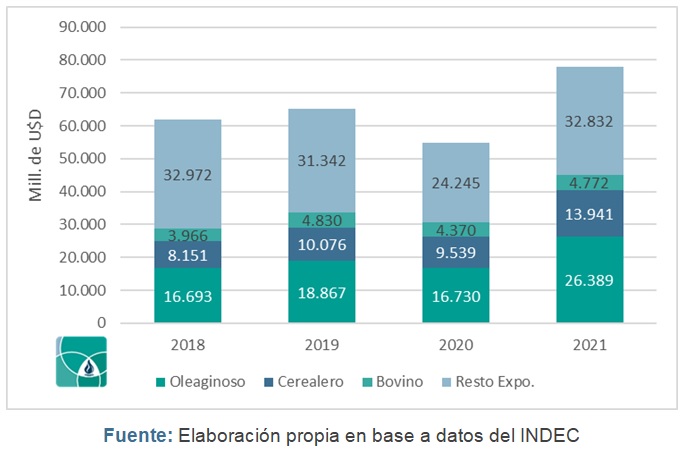
Exportaciones argentinas por complejo, en millones de dólares, de 2018 a 2021.The availability of foreign currency and domestic political stability depend on maintaining a high international commodity price scenario. If the world scenario were to change, the chances of the domestic economic crisis being resolved without a sudden social upheaval would be drastically reduced. We invite you to read the full report.
Open access, for use and citation
The report is available freely and without charge, under a Creative Commons license (CC BY-NC-SA 4.0):
- 📄 Full report (PDF): Download the report
- 🗄️ UNR Hypermedia Repository (RepHip): https://hdl.handle.net/2133/25129
- 📚 More reports from the Observatory: Index of Reports
Bendita Soja | Producción y mercados de granos. Informes del Observatorio UNR N.º 58 — Serie Informes de Coyuntura N.º 21, noviembre de 2022. ISSN 2683-9067 / 2683-9075. Autor: Alfredo O. Bula.